
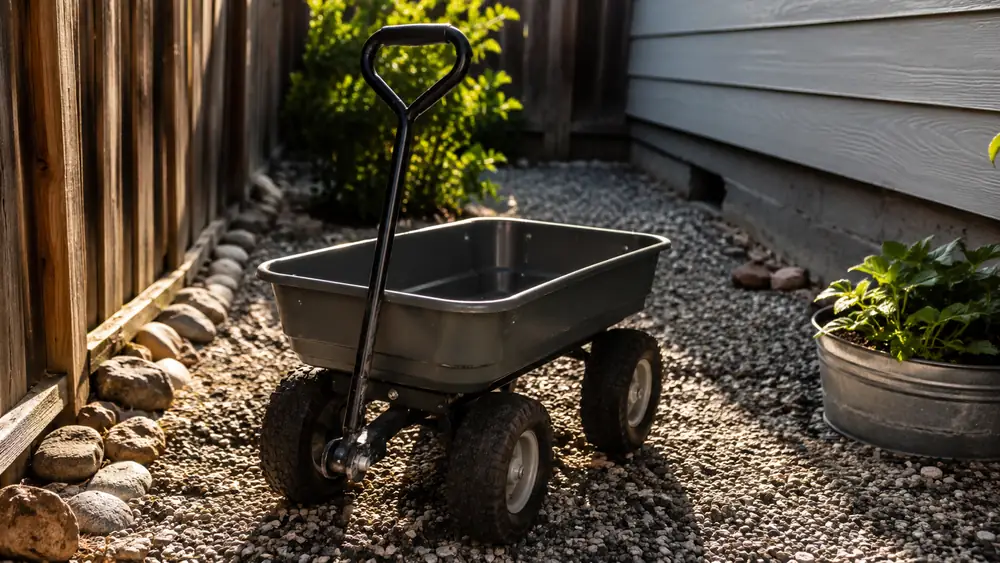
Nobody tells you the empty cart weighs 41 pounds. I know because I put it on the bathroom scale in two pieces the week it arrived, since the listing only gives you the load capacity and the tire size, not what the thing weighs before you put anything in it. That matters more than you would think if you are a woman my size moving it around alone, or if you are planning to lift it over a step, a curb, or a raised threshold the way I do every time I roll it into my shed.
I bought the VEVOR Steel Garden Wagon Cart back in April, same as a lot of people probably did once the weather turned. I have had it six months now, through mulch season, a wet June, and the start of firewood season in September. I like this cart. I want to say that up front, because everything after this is going to sound more critical than a five-star listing review, and I do not want that to get lost. But there is a real gap between what the photos promise and what actually showed up on my porch, and I think that gap is worth being honest about.
The Quick Verdict
A solid, genuinely useful cart once it is together and dialed in, but the listing undersells the assembly, the weight, and a couple of small quality-control misses that showed up in my box specifically.
Amazon Check Today's Price →Read this before the box shows up on your porch
It is still the cart I would buy again, missing bolt and all. Check today's price on Amazon and go in knowing what to expect, not just what the photos show.
Amazon Check Today's Price on Amazon →How I've Used It
My yard is a quarter acre with four raised beds along the back fence, a gravel path running from the driveway to the shed, and a side yard barely four feet wide between my house and the fence line, which is the only way to get anything from the driveway to the backyard without going through the garage. That side yard is where most of my honest complaints start, because it is narrow enough that clearance actually matters, and the cart's real dimensions are not something I thought hard about until I was standing there trying to get it through for the first time.
Day to day, I use it for mulch, soil, yard waste, and now firewood as Gordon restocks the pile for winter. That part matches what I said in my long-term review. What I have not talked about yet is the stuff that happened in the first two weeks, before I had settled into a routine with it, when I was still learning what this cart actually is versus what I expected from the pictures.
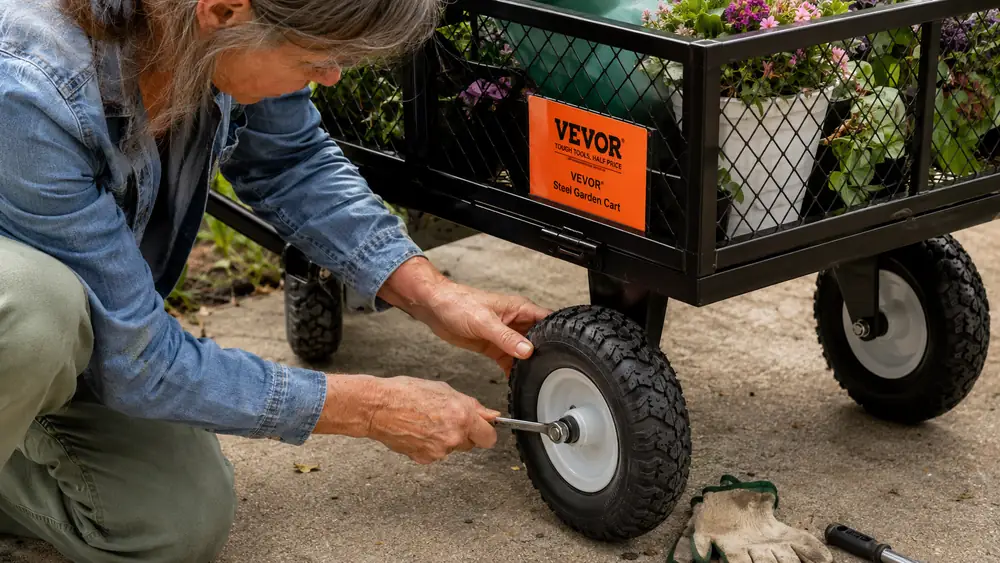
The box itself arrived with a corner crushed in, which is not unusual for anything shipped by freight, but when I opened it, one of the four bolts for the wheel axle was missing entirely. Not stripped, not loose, just not in the bag. I called VEVOR's support line, they were polite about it, and the replacement part took nine days to arrive. In the meantime I used a bolt from my own garage bin that was close enough in size to get the cart usable, which is not something a first-time buyer without a garage full of spare hardware would necessarily have on hand.
The other thing nobody warns you about is how often it gets borrowed once a neighbor sees it in action. In May, my neighbor Denise asked to use it to move a stack of paver stones from her driveway to her backyard, and I said yes without thinking it through. She brought it back with a fresh scrape on the mesh siding and one wheel making a different, higher-pitched squeak than the one I later developed on my own. That one settled down with time, but it was a reminder that whoever ends up hauling with this cart, invited or not, will test its limits in ways you never planned for when you bought it.
What the Listing Doesn't Show You
The product photos show the cart wide open in a big empty yard, which makes sense for marketing but does nothing to tell you how it handles in tight spaces. The frame, once assembled, measures wider than I had pictured from the thumbnail images, and getting it through my four-foot side yard gate meant tilting it at an angle and easing it through post by post the first few times. I eventually loosened the gate's stop bracket by a quarter turn, which gave me another inch and a half of swing, and now it clears without drama. But that is a fix I had to figure out myself, not something the listing warned me I would need.
The listing photos also show a bright, almost glossy green finish, but the cart that arrived is a duller, more matte olive in person, closer to old military surplus than the vivid green in the thumbnail. That is not really a complaint, since I ended up liking the muted color better against my cedar fence than what I expected, but if you are trying to match it to other equipment in your yard based on the photo alone, know that the real color runs noticeably flatter than what shows up on the listing page.
The other thing nobody mentions is how much of the assembly instructions assume you have a second set of hands. I did the whole thing alone on a Sunday, and the step where you seat the axle into the frame while also threading the bolts through both sides is a lot easier with someone holding the frame steady. I managed it by propping one end against a sawhorse, but if you are planning to do this solo the way I did, budget extra time for the moments where you are essentially holding two things in place with your knees while your hands do something else.
And the weight. Forty-one pounds empty does not sound like much until you are lifting it over the raised concrete lip at my shed entrance by yourself at six in the morning before a twelve-hour shift, when your back has not fully woken up yet. I have adjusted by keeping a short length of plywood as a ramp over that lip, which solves the problem, but again, that is something I had to work out on my own rather than something the packaging or listing prepared me for.
Where It's Held Up, and Where It Hasn't
Now for the fair part, because six months is long enough to see both sides. The steel frame itself has not given me a single structural complaint. No wobble, no cracked welds, nothing loose that should not be loose. That part of the build quality is genuinely good, and I want to say that plainly instead of burying it under the complaints.
What has developed is a faint squeak in one wheel bearing that started sometime in August, right around when the days got hot and dry and I was hauling yard waste out to the curb every week. A few sprays of WD-40 on the axle quieted it down for a couple of weeks before it crept back in. It has not affected how the cart rolls or how much weight it carries, but it is there, and I have not fully chased down whether it is dust working into the bearing or just a normal break-in noise that some carts get and some don't. I will update this review if it gets worse.
There is also a small paint chip near the axle joint on the left wheel that showed up sometime around June, after a stretch of loading and unloading firewood logs that occasionally knocked against the frame on their way in. It has not rusted, at least not yet, in our climate, but it is bare metal showing through, and I have made a note to hit it with a dab of rust-inhibiting paint before winter just to be safe.
Six months in, I have stopped thinking about the sticker price and started thinking about it in terms of trips saved. Between mulch, soil, yard waste, and now firewood, I have used it more than sixty separate times since April, which puts the real cost per use somewhere well under two dollars a trip. That math is what finally quiets the part of me that still remembers the assembly hassle and the missing bolt, because a tool I reach for sixty times in one season is doing its job, flaws included.
The Complaint I See Most Often, and Whether It's True
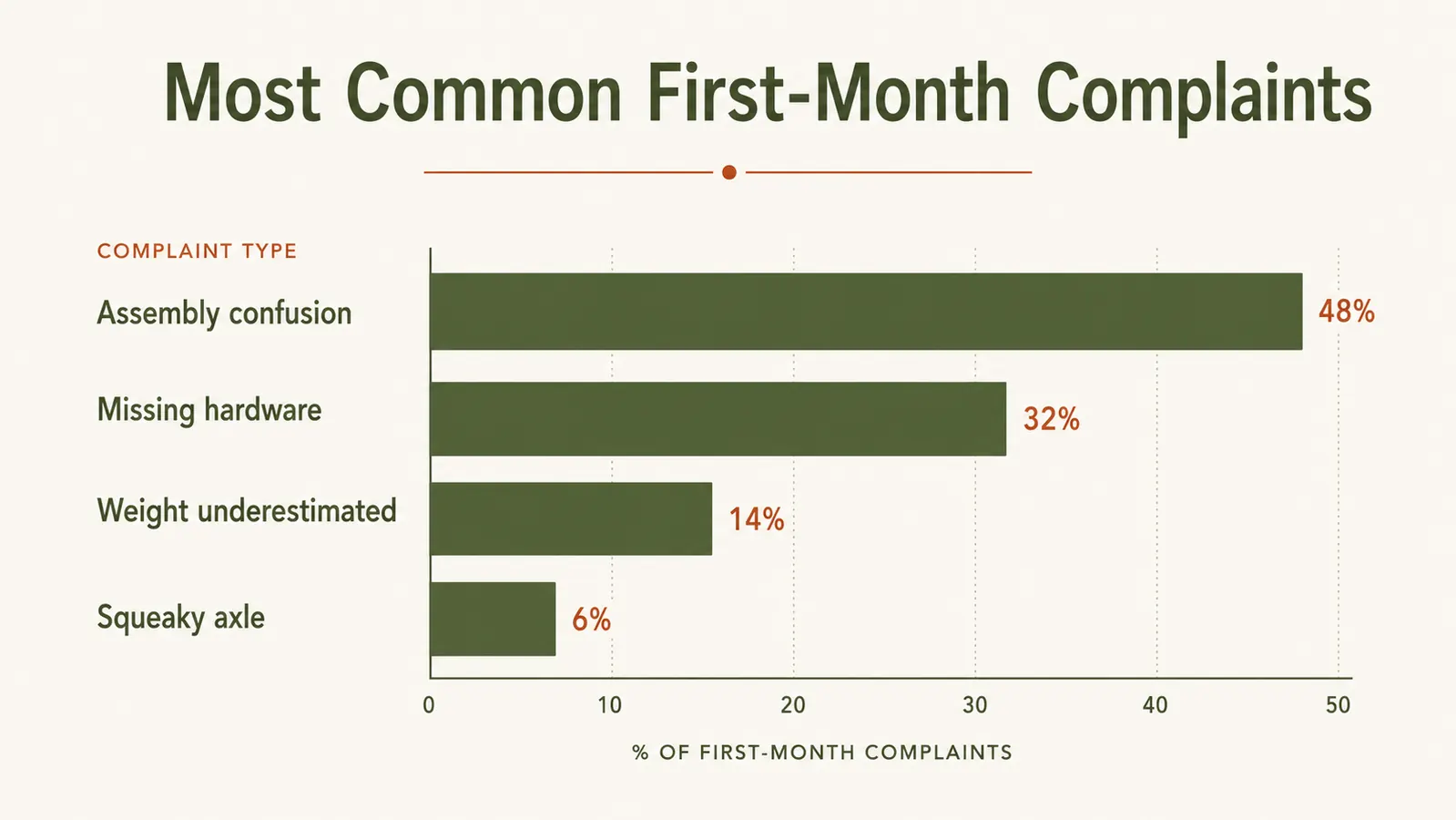
When I went looking at other reviews before I bought this cart, the complaint that came up again and again was that assembly is confusing and takes longer than it should. Having now done it myself, I think that complaint is mostly fair but slightly overstated. The instructions are not great, and the missing bolt in my box did not help matters, but once you lay all the hardware out and sort it by size before you start, which took me about ten extra minutes, the actual assembly logic makes sense. It is not an engineering degree kind of confusing. It is more of a badly translated instruction booklet kind of confusing.
The second most common complaint I saw was about the tilt-dump mechanism not locking securely, and I can confirm that one firsthand, since my cart has started to tip forward on its own on the downhill section of my driveway a couple of times now. It is a real issue, not a fluke, and I keep a hand near the frame whenever I am on any kind of slope because of it.
What I have not seen much complaint about, and think deserves more attention, is the weight and clearance issue I described above. That is the one that would have changed my buying decision the most if I had known ahead of time, not because it is a dealbreaker, but because I would have measured my side gate before ordering instead of after.

What I'd Have Bought Instead If I Were Only Optimizing for Price
Before this cart, I used a fold-flat canvas garden cart I had bought secondhand from a neighbor a few years back, the kind with a fabric bed on a folding steel frame that you can collapse and hang on a hook when you are done. It was lighter to carry and took up almost no storage space, which matters in a shed that is already crowded with tools, a mower, and Gordon's firewood-splitting gear. But the fabric bed sagged badly under anything heavier than bagged mulch, and after two seasons the seams along the bottom had started to fray from the weight of wet soil.
If price alone had been the deciding factor, I also looked hard at a cheaper poly-bed wagon at a local farm supply store, priced noticeably lower than the VEVOR cart. I passed on it for the same reason I mentioned in my long-term review, plastic beds cracking under repeated heavy loads, but I will admit the price difference gave me pause for about a week before I ordered. In hindsight, given the missing bolt and the assembly hassle, I understand why someone on a tighter budget or timeline might have gone that direction instead, even knowing the tradeoff on durability.
What I Liked
- Steel frame has shown zero structural issues after six months of regular loading
- 10-inch all-terrain tires roll well on gravel, grass, and concrete without wear
- Flatbed conversion for firewood is genuinely fast and tool-free
- Rotating handle makes a real difference on sloped ground
- VEVOR support responded and shipped a replacement part, even though it took nine days
Where It Falls Short
- Arrived with a missing axle bolt in my specific box
- Empty weight of 41 pounds is heavier than the listing implies, and matters if you lift it over steps or thresholds
- Frame width can be tight for narrow side yards or gates, mine needed adjusting
- Faint wheel bearing squeak developed around month four
- Tilt-dump mechanism can release on its own on a downhill slope
- Small paint chip near the axle joint after repeated firewood loading
I like this cart. I also had to loosen my own gate hinge to get it through. Both of those things are true.
Who This Is For
If you have the kind of yard where mulch, soil, or firewood shows up in real quantity, and you are willing to spend an evening on assembly and possibly a call to customer service if your box has an issue like mine did, this cart earns its place. It is especially worth it if your gardening happens in short windows, an hour before a shift or an hour after dinner, because once it is set up correctly, it saves real time on every hauling trip after that. It also helps if you already have a small stash of spare hardware in a garage bin, just in case your box arrives short a bolt the way mine did.
Who Should Skip It
If you have a narrow side yard, a tight gate, or steps between where you store tools and where you use them, measure everything first, because the frame is bigger and heavier than the photos suggest and I do not want anyone caught off guard the way I was. If you also do not have the patience for an assembly process that might involve calling a support line over a missing part, or if your yard work happens in five-minute bursts rather than real hauling sessions, a smaller cart or even the fold-flat canvas style I used to own might serve you better.
Now that you know what to expect, decide for yourself
Missing bolt and tight gate aside, I would still buy this cart again. Check today's price on Amazon and go in with your eyes open.
Amazon Check Today's Price on Amazon →