
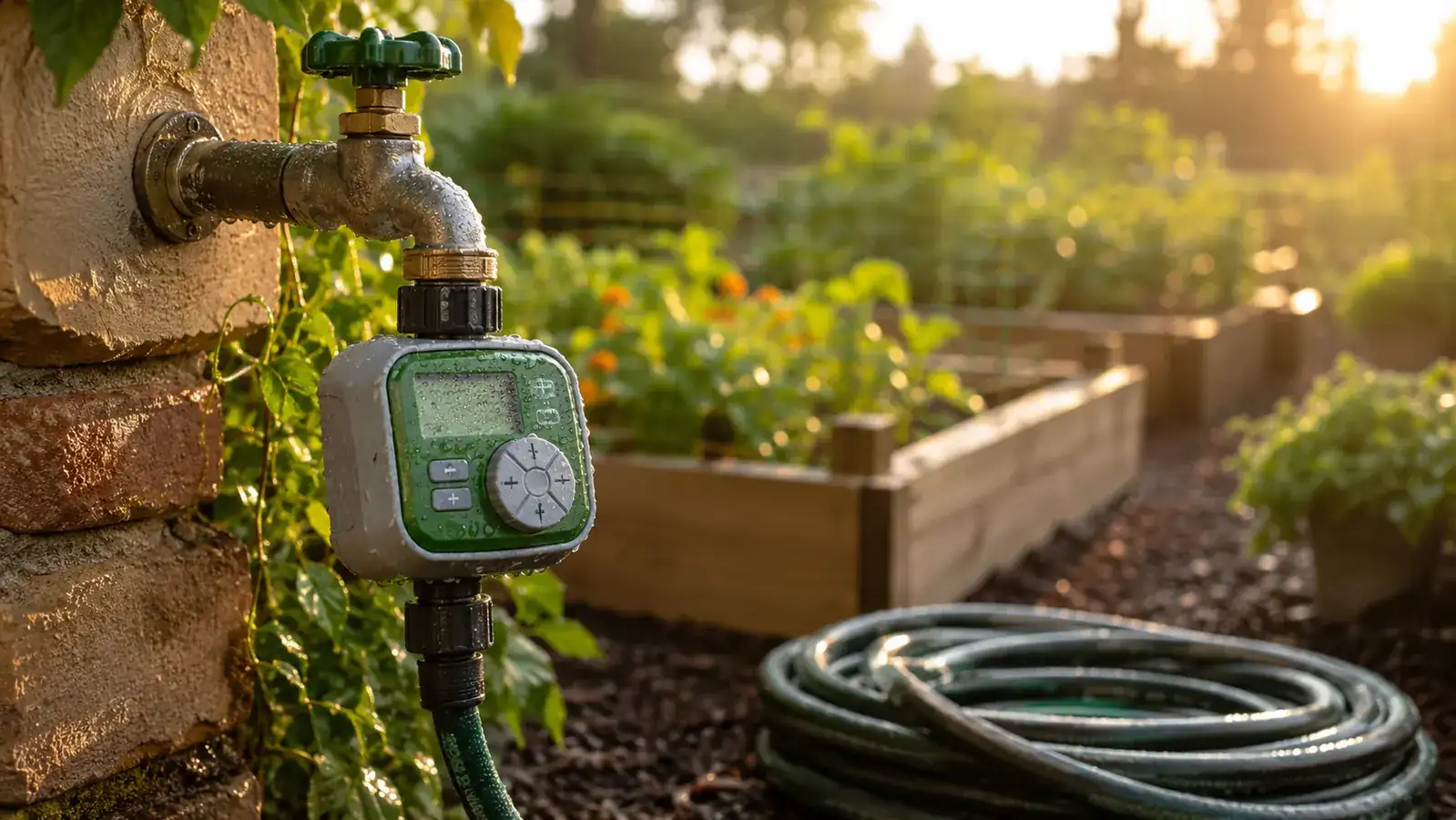
Short answer: if your garden time comes in scattered windows, before a shift starts or after the dishes are done, the Orbit Programmable Digital Hose Watering Timer earns its keep. I've had mine threaded onto the spigot behind my tomato beds for two full growing seasons now, and it does the one thing a manual dial timer never quite can. It remembers to water when I forget to remember.
But I still keep an old manual mechanical timer in the shed, and it isn't just a backup. There are jobs where the simple twist-dial timer beats the Orbit outright, no batteries, no menu screen, nothing to reset after a power dip or a dead cell. This comparison is built on actually running both, side by side, on the same hose bib, through one hot Ohio summer and one wet spring that put the Orbit's rain delay to a real test.
How I Set These Up Side by Side
I run two hose zones off the back of the house, one feeding the raised vegetable beds and one feeding a strip of roses along the fence line. Last May I put the Orbit on the vegetable zone and left the old manual dial timer, the kind you twist like an oven timer, on the rose zone. Same water pressure, same clay-heavy soil, same stretch of full sun from about ten in the morning until early evening. Nothing about the setup favored one timer over the other.
I work three twelve-hour shifts a week, so my actual gardening time comes in narrow slices, six in the morning before I leave the house, or whatever daylight is left after dinner on the days I'm off. That's the lens this whole comparison runs through. A tool that needs me to remember it every single day already isn't built for how I actually garden, and I suspect it isn't built for how most of you garden either.
I kept a small notebook by the back door all season, one line each evening: did the vegetable beds get water today, did the roses, and if not, why. It's a low-tech way to track a comparison, but after four months it told me everything I needed to know about which timer actually does the job when nobody's watching. I also wrote down the mornings I was too rushed to even glance at either one, which turned out to matter as much as the setup itself.
Neither timer got special treatment. I didn't baby the Orbit with fresh batteries every month or clean the manual dial more than I normally would. The whole point was to see what happens to each one after a full season of ordinary, distracted use, the kind every working gardener actually gives their tools.
| Feature | Orbit Digital Timer | Manual Mechanical Timer |
|---|---|---|
| Today's price range | Around $29.99, check current price | Roughly $12 to $18 depending on brand |
| Power source | 2 AA batteries, replace roughly twice a season | None, fully spring-wound dial |
| Programming | Multiple start times per day, repeats automatically | One countdown per twist, up to about 2 hours, no repeat |
| Rain delay | Built-in rain delay button, skips a cycle without resetting the whole schedule | None, you have to remember to shut the water off yourself |
| Display | Backlit LCD screen, readable in low morning light | Printed dial markings only, no screen |
| Water resistance | Water-resistant housing rated for outdoor spigot use | Fully mechanical, no electronics to protect from moisture |
| Best suited for | Multiple weekly waterings with nobody home to run the hose | Occasional, hands-on watering sessions you plan to walk away from briefly |
| Most common failure | Batteries die quietly, display can dim in extreme heat | Dial can stick with grit, housing can crack in a hard freeze |
Where the Orbit Digital Timer Wins
The single biggest difference showed up in my notebook by week three. The manual timer only runs once per twist, so if I forgot to reset it after the morning cycle, the rose bed simply didn't get its evening water. That happened eleven times over four months, almost always on a day I worked a double or picked up an extra shift. The Orbit doesn't have that failure mode. I set it once in April, morning and evening cycles on the vegetable zone, and it ran on schedule whether I was home, at work, or asleep.
The rain delay button matters more than I expected going in. We had a stretch in June with three storms in five days, and instead of manually shutting off the water each time or letting the beds get waterlogged on top of an inch of rain, I pressed the rain delay and the Orbit skipped the next scheduled run without me touching the programming again. The manual timer has no equivalent. If I wasn't home to twist it off, the water just ran on schedule regardless of what the sky was doing.
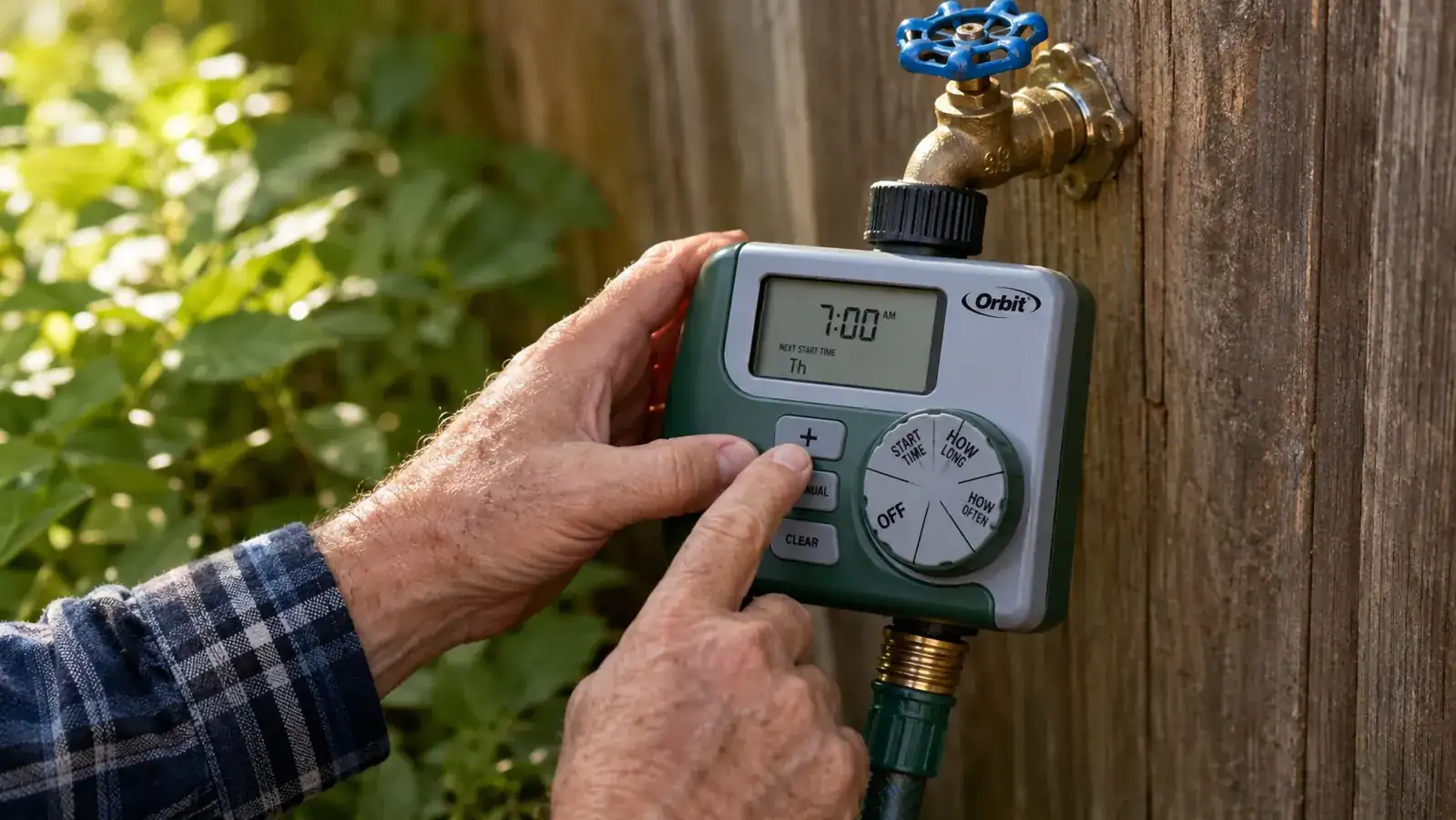
The LCD screen sounds like a small thing until you're standing at the spigot at six in the morning trying to read settings before the sun is fully up. The backlit display made adjustments quick, even half awake with coffee in one hand. And because the programming holds even after I swap the batteries, I haven't had to redo a schedule from scratch since I first set it two seasons ago.
It also handled the hottest stretch of July without a hiccup, three days over ninety-five degrees where the vegetable beds needed a short midday cycle on top of the regular morning and evening runs. I added the extra start time in about two minutes standing at the spigot before my shift, and it stuck without me having to think about it again for the rest of that heat wave.
Where the Manual Mechanical Timer Wins
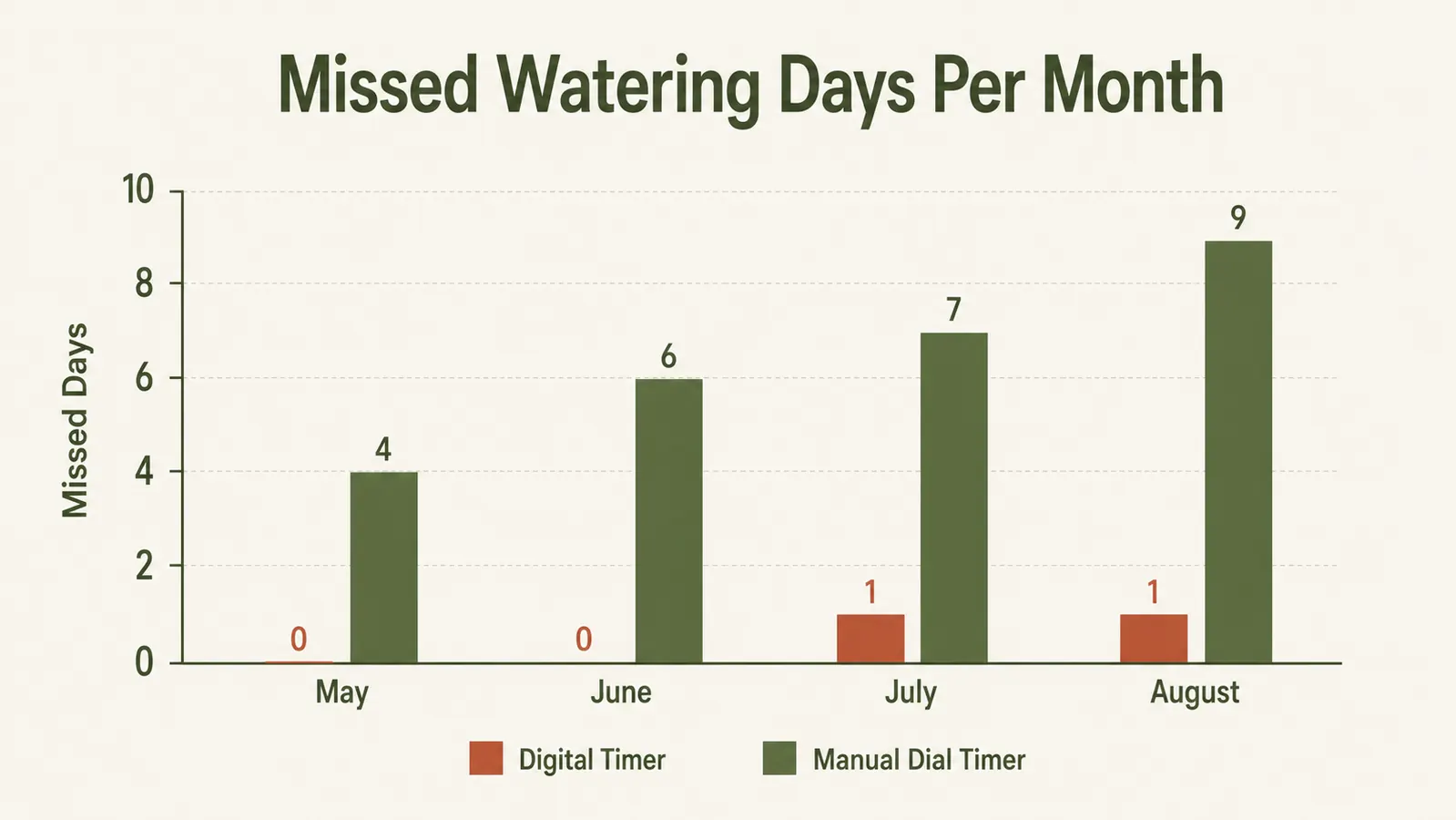
Simplicity is the manual timer's whole argument, and it's a real one. There's nothing to program wrong, no menu to scroll through, no batteries to forget to buy at the hardware store. My neighbor borrows the manual timer whenever she's watering a new planting for just a week or two, because she can hand it to her teenager with a thirty-second explanation. Nobody's explaining a multi-day watering schedule to a fifteen-year-old in thirty seconds.
It also just costs less up front, and for a lot of jobs that's the right call. If you're watering a single new shrub for two weeks after planting, or you want to run a sprinkler for exactly forty minutes while you're out front weeding, a twist-dial timer does that job with zero setup and zero electronics to worry about. I don't reach for the Orbit for quick, supervised jobs like that. It's overkill.
There's also something to be said for a tool with no display to fail. Through two winters in the shed, unplugged and unattended, the manual timer has never once needed troubleshooting. It just works the next spring, same as it always has. The Orbit needs fresh batteries and a quick reprogram after winter storage, which is a small task, but it is a task the mechanical timer skips entirely.
I'll also say the manual timer travels well. I've thrown it in a bucket with other tools and hauled it over to help a friend water her new hedge row for a weekend, no worries about it getting jostled or a setting getting knocked loose. The Orbit stays put on my own spigot, and honestly, that's fine, it wasn't bought to be portable.
Stop losing whole watering cycles to a forgotten dial twist.
If your garden time comes in short windows around a work schedule, the Orbit Programmable Digital Hose Watering Timer holds a real program so the water runs whether you're home or not.
Amazon Check Today's Price on Amazon →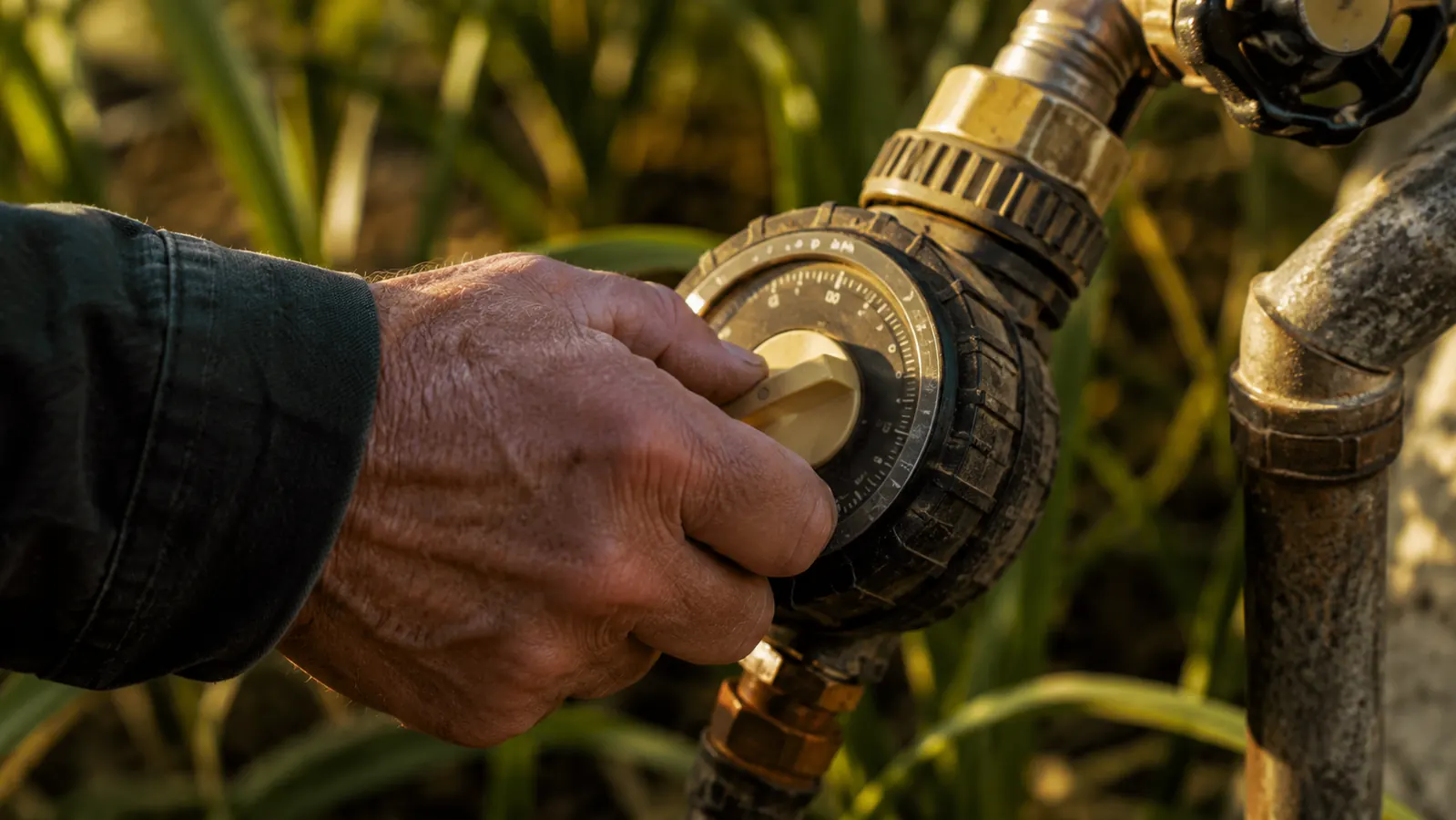
The Real Cost Comparison
On paper the manual timer looks like the cheaper buy, and the sticker price is lower. But cost isn't just the tag. Over two seasons, the eleven missed watering cycles on my rose bed meant three plants needed replacing that summer, roughly $35 in nursery stock, plus the time spent replanting on an evening I didn't really have to spare. The Orbit's rain delay also saved a soggy bed from root rot during that wet June stretch, which is the kind of cost you don't see until a plant just quietly dies weeks later.
The Orbit does have an ongoing cost the manual timer doesn't, batteries. I replace mine roughly twice a season, which runs about $6 a year in AA batteries. That's a small number next to what a missed watering cycle can cost you in replanting, and it's worth factoring in honestly rather than pretending the digital timer is free to run once you've bought it.
Add it all up over a full season and the manual timer's lower price tag doesn't hold up the way it looks on the shelf. A few dollars in batteries against a handful of replaced plants and a couple of evenings spent replanting isn't a close call for anyone whose schedule looks like mine.
Who Should Buy Which
If you work shifts, travel for a few days at a stretch, or simply can't be home reliably at the same time every day, the Orbit Digital Timer is the one that actually fits your life. It's built for the gardener whose watering has to happen on a schedule the gardener isn't there to enforce. That's most of the people reading this, and it's certainly been my situation for two years running.
If you're watering a single new planting for a couple of weeks, running a sprinkler while you're outside anyway, or you just want the cheapest, most foolproof option in the shed for one-off jobs, the manual mechanical timer still earns its spot. I use mine three or four times a year for exactly that kind of job, and I have no complaints about it in that role. It just isn't the tool for a full season of unattended watering.
My honest setup, after two seasons of running both, is the Orbit on the zone that matters most and needs to run whether I'm home or not, and the manual timer in the shed for the short, supervised jobs that pop up a few times a year. If I had to keep only one, though, it's the Orbit, because it's done the job every single day I couldn't be there to do it myself.
If your schedule doesn't wait for you to remember the hose, this timer will.
Two seasons in, the Orbit is still the one thing on my spigot I trust to run without me standing there.
Amazon Check Today's Price on Amazon →