I bought the Fiskars Stand-Up Weed Puller on a Saturday in April, mostly because my knees had started telling me no every time I knelt down to deal with the dandelions taking over the side bed. I'd been putting off buying one for two summers, telling myself a hand trowel and a pair of old garden gloves were good enough. They weren't. By the time I gave in and ordered this one, the side bed had gone from a scattering of dandelions to something closer to a solid yellow carpet, and I was down there on my knees three or four evenings a week just trying to keep up.
I've now used the Fiskars through a full growing season, from that first April weekend through a hot, dry July and into a wet September that brought back every weed I thought I'd beaten in June. It's been out of the shed almost every week I've had time to garden, which for me usually means an hour after dinner or forty-five minutes before an early shift, so this review is built on real, repeated use, not one good afternoon with it.
The Quick Verdict
A sturdy, genuinely back-saving tool that pulls most common weeds clean on the first try, with a claw mechanism that's held up through a full season of regular use.
Amazon Check Today's Price →Tired of your knees paying the price for a weedy side bed?
This stand-up weeder let me clear the same beds without kneeling once, in less time than I used to spend with a trowel. See today's price on Amazon.
Amazon Check Today's Price on Amazon →How I've Used It
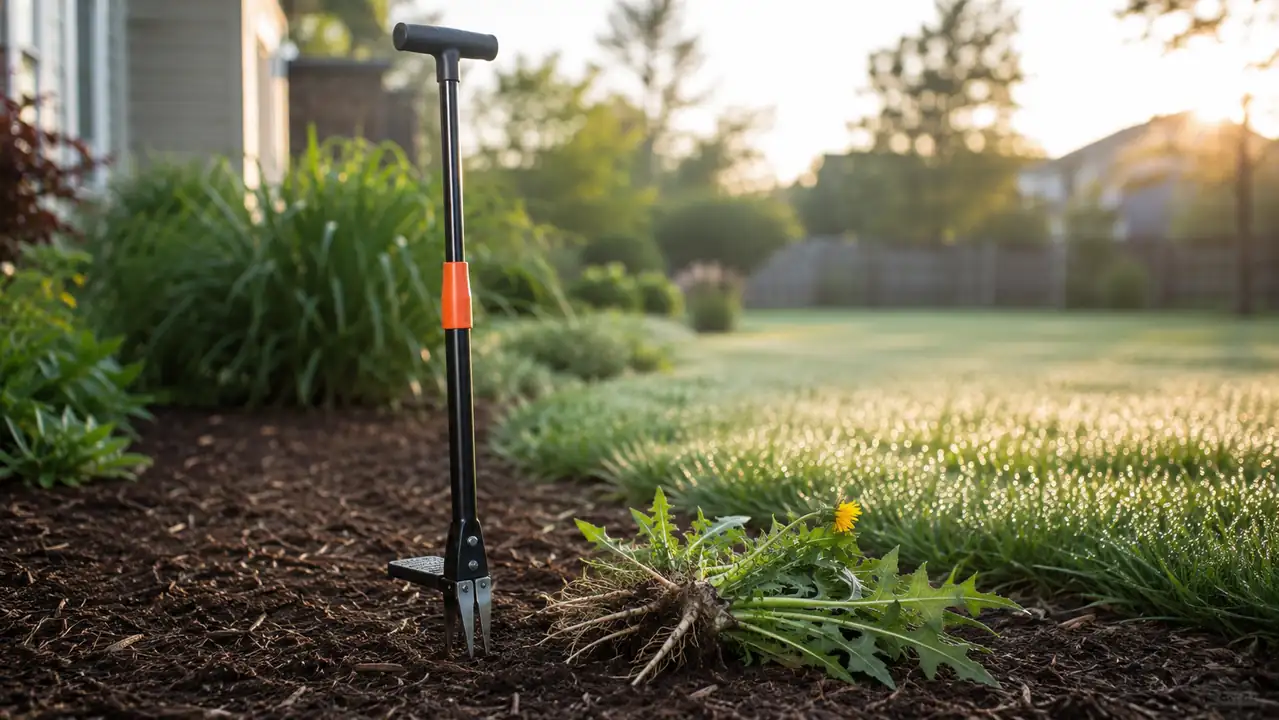
My routine with this tool settled into something predictable pretty fast. I walk the bed, spot a weed, set the four claws around the base of it, step down on the foot platform with my full weight, and pull back on the offset handle. Most of the time that's the whole job, one motion, done standing up. I've used it on the side bed along the driveway, the raised vegetable beds, and a long stretch of clay soil along the back fence that has never been generous to any tool I've owned.
The offset handle took me a week or two to get used to. It's angled so your hands stay out ahead of your feet instead of directly above the weed, which felt strange the first few times I used it and then started to feel obvious, the same way a good tool usually does once you understand why it's shaped that way. I'm five foot six, and the 39 inch length puts the handle right around hip height for me, so I'm standing up fully straight the entire time, no hunching over the way I do with most long-handled garden tools.
By June I wasn't thinking about the mechanics of it at all anymore. I'd walk out with a cup of coffee before an early shift, spend twenty minutes working down one row of the vegetable bed, and be back inside before the coffee went cold. That twenty minutes used to mean kneeling on a foam pad, getting my knees dirty, and needing to stretch my lower back afterward. Now it's just something I do standing up, the same way I'd walk the dog.
The Foot Platform and Digging Into Real Soil
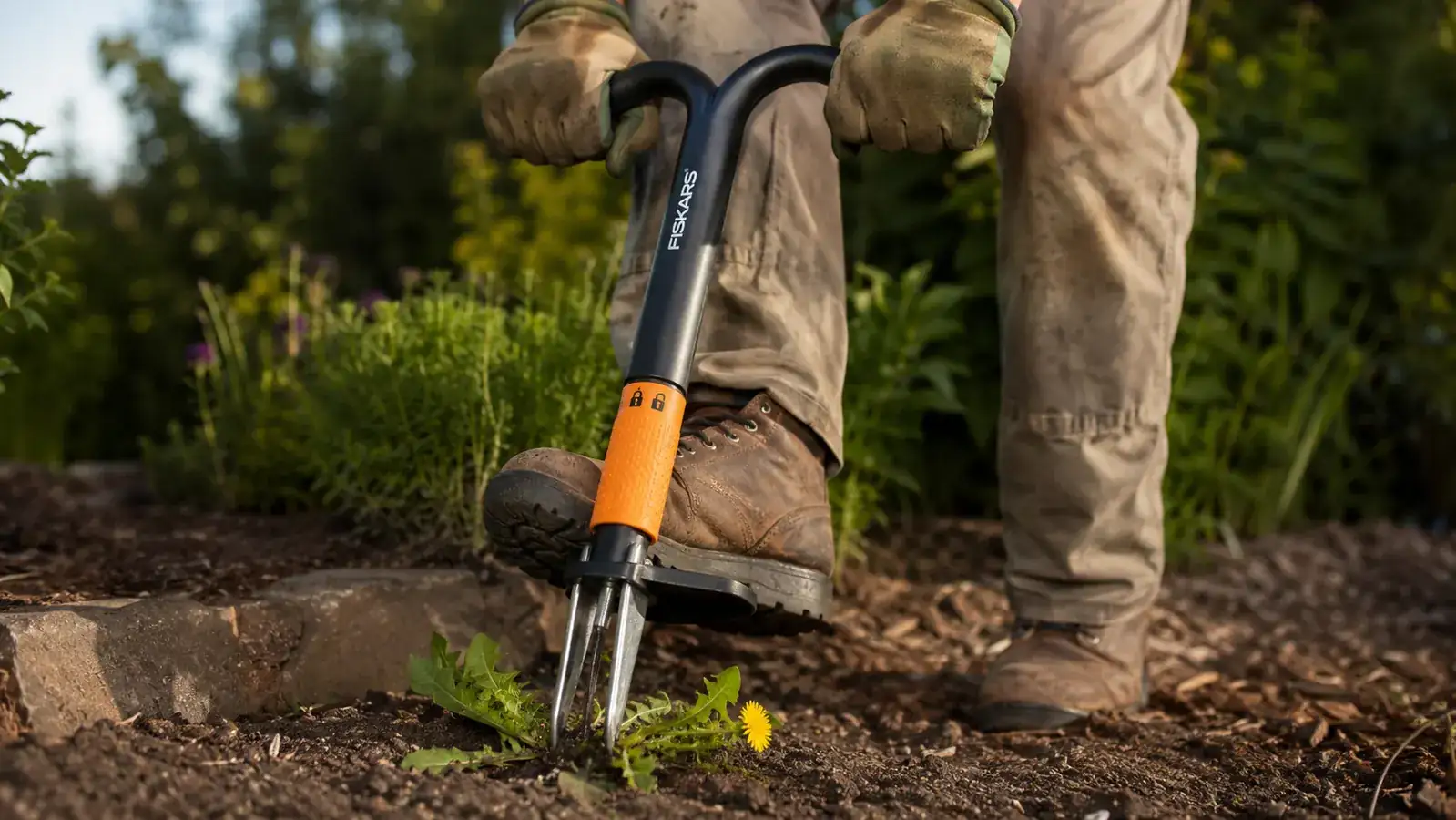
The reinforced foot platform is the part I was most skeptical about before buying, since I'd read reviews of other stand-up weeders where the platform bent or the claws just skated across hard ground without penetrating. My yard has two very different soil types, loose loamy soil in the raised beds and dense clay along the back fence that's closer to pottery than dirt by August. I tested the weeder in both on purpose, within the first week, to see if it would hold up where it actually mattered to me.
In the raised beds it goes in with almost no effort, barely more than my own body weight pressing down. In the clay along the fence, it takes a real stomp, sometimes two, and I've had to rock the handle slightly side to side to work the claws deeper before pulling. That's more effort than the raised beds, but it's still less effort and less time than I ever spent trying to work a hand trowel into that same clay, which mostly just bounced off the surface until I'd loosened it with a garden fork first.
After a full season of stepping on it, hard, in clay soil more times than I've bothered to count, the platform itself shows no bending or cracking. There's some scuffing on the metal where my boot sole has worn a slight shine into it, but structurally it feels exactly as solid as it did the first week. That matters to me more than almost any other spec, because a bent platform on a tool like this basically ends its usefulness.
The Claw Mechanism, Six Months In
The four serrated claws close around the root ball when you pull back on the handle, and the eject mechanism pushes the pulled weed clear when you push the handle forward again, so you're never bending down or using your hands to pull anything out of the claws. In practice, this is the single biggest reason I use the Fiskars as often as I do. With a trowel, half the job was crouching down afterward to actually grab and remove what I'd loosened. This one drops the weed at your feet without you touching it, which sounds small until you've done it forty times in a single evening and realize your back never once bent.
The claws have stayed sharp enough to bite into soil cleanly all season, though I did notice by August that a few of the serrated teeth had picked up small nicks, most likely from a patch of the back fence bed where I know there are buried landscape edging stones I never fully dug out. That's on my soil, not the tool, but it's worth knowing that if you're weeding around old buried hardscaping, you may see some wear on the claw edges over time.
The eject action itself has never once jammed on me, even when I've pulled up a weed with a bigger, denser root ball than the claws were really built for. It just takes a firmer push forward to clear it. I keep a garden hose nearby and rinse the claws off every few uses, mostly out of habit from watching clay dry into a hard crust on other tools I've owned, and that alone seems to be enough maintenance to keep it working the way it did on day one.
What It Actually Pulls Clean, and What It Doesn't
Dandelions are where this tool earns its keep. The taproot comes up whole almost every time, no snapping off halfway down the way it does with a trowel, which means the same dandelion doesn't come back three weeks later from a broken root left in the ground. I'd guess I've pulled somewhere close to two hundred dandelions with this thing since April, and I can count on one hand the number that snapped instead of coming up clean.
Bindweed and any of the running, spreading weeds with shallow horizontal roots are a different story. The claws are built to grab a single central root, and bindweed doesn't grow that way, it spreads sideways just under the surface. I've had some luck catching a runner where it crosses a bare patch, but for a real bindweed problem, this tool is a supplement to hand-pulling and smothering, not a replacement for it. Thistle sits somewhere in the middle. The taproot is deep and tough, and it usually takes two solid stomps and a firm pull to bring the whole thing up, but it does come up whole more often than not, which is more than I can say for any hand tool I've tried on thistle before.
Crabgrass and other shallow-rooted grassy weeds pull fine, though honestly a hoe or a hand pull works nearly as well on those since the roots barely go down at all. Where this tool separates itself is on anything with a real taproot going down four or more inches, which in my yard means dandelions, thistle, and the occasional stray burdock seedling before it gets established.
Comparing It to the Hand Trowel I Used for Fifteen Years
I want to be fair to the trowel here, because I used one for fifteen years and it did the job, just at a cost I stopped noticing until it was gone. A trowel gets you closer to the weed, lets you see exactly what you're cutting around, and it's cheaper and simpler with nothing that can break. For small, precise work near delicate seedlings, I still reach for a hand trowel over this weeder, since the claws are built for a full-sized weed, not for working carefully around something you're trying not to disturb.
But for the actual bulk of my weeding, clearing a bed of dandelions or thistle before they seed, the trade-off has been obvious. Kneeling for twenty minutes with a trowel left my knees sore and my lower back tight afterward, every single time, and it only got worse as the season wore on. With the stand-up weeder, I've cleared longer stretches of bed in less time and walked away with nothing sore. If you're weighing the two side by side for your own yard, it really comes down to how much of your weeding is precision work near seedlings versus clearing established weeds from open beds and lawn edges, since the two tools genuinely solve different problems.
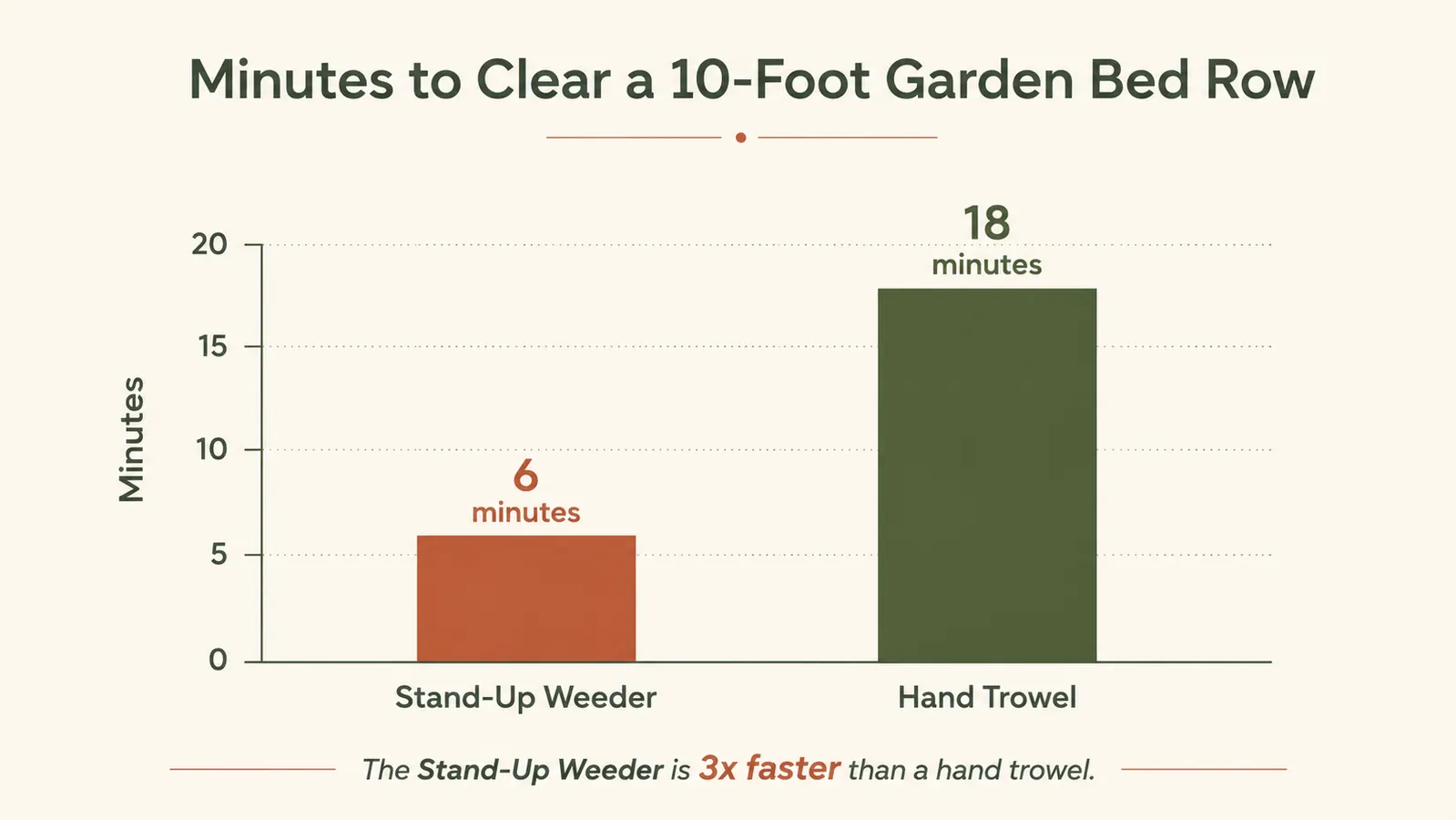
The other difference is speed. I timed myself one evening in June, clearing a ten-foot stretch of the vegetable bed row with the stand-up weeder, then clearing an equal ten-foot stretch the next evening with my old trowel. The weeder took just under six minutes. The trowel took closer to fourteen, most of that extra time spent kneeling down, digging, then standing back up to toss the weed in the bucket before kneeling again for the next one. Over a full season of regular weeding, that difference adds up to real evenings I got back.
What I Liked
- Taproot weeds like dandelion and thistle come up whole almost every time
- No kneeling or bending required for the entire weeding session
- Foot platform held up through a full season of clay soil with no bending
- Eject mechanism has never jammed, even on denser root balls
- Noticeably faster than a hand trowel for clearing open beds
Where It Falls Short
- Not effective on bindweed or other shallow, spreading root systems
- Too bulky for precise work close to seedlings or delicate plants
- Claw teeth showed minor nicks after hitting buried edging stones
- Takes real effort, sometimes two stomps, to penetrate dense clay soil
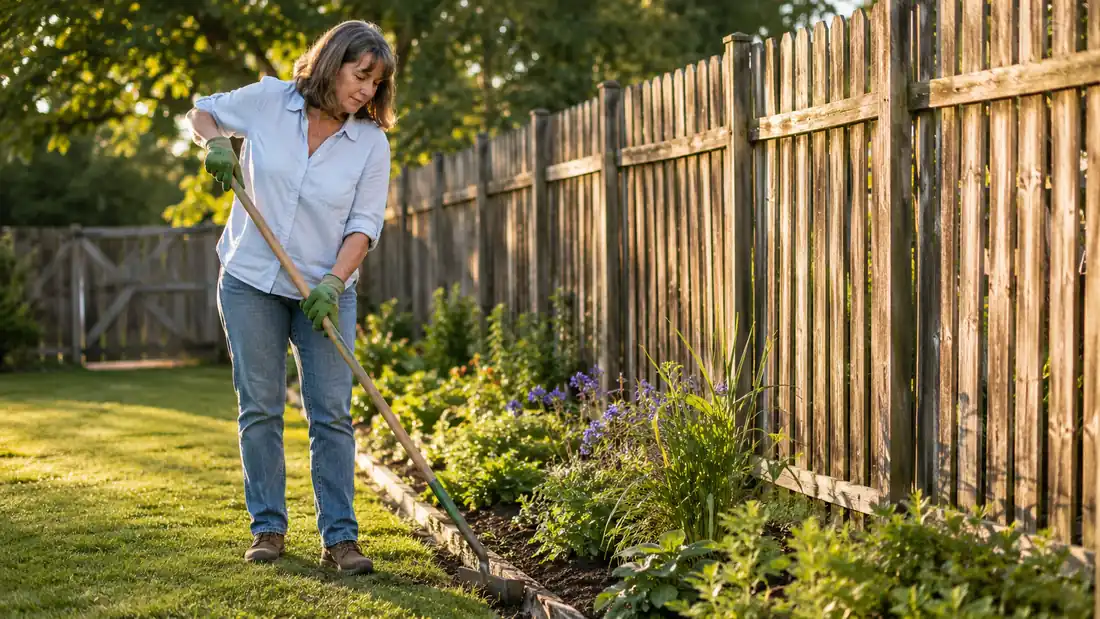
By June I wasn't thinking about my knees at all anymore, and that's when I knew the tool had actually changed something.
Who This Is For
If you're dealing with dandelions, thistle, or any other taproot weed across an established bed or lawn edge, and you're doing your gardening in short windows before work or after dinner, this tool earns its keep quickly. It's also the right call if kneeling has become something you actively avoid, whether that's from a bad knee, a bad back, or just not wanting to spend your limited garden time getting up and down off the ground. A full season of regular use is the real test for the Fiskars, and it's held up to mine.
Who Should Skip It
If your main weed problem is bindweed, quackgrass, or another spreading, shallow-rooted type, this tool will help a little but it won't solve it, and you're better off pairing it with hand-pulling or a smothering approach. It's also not the right tool if most of your weeding happens in tight spaces close to seedlings, containers, or delicate perennials, where a hand trowel still gives you more control. For clearing open ground of established taproot weeds, though, I haven't found a hand tool that beats it.
A full season in, and my knees still thank me for this one.
If dandelions and thistle keep winning the fight against your back, this is the tool that finally turned it around for me. See today's price on Amazon.
Amazon Check Today's Price on Amazon →